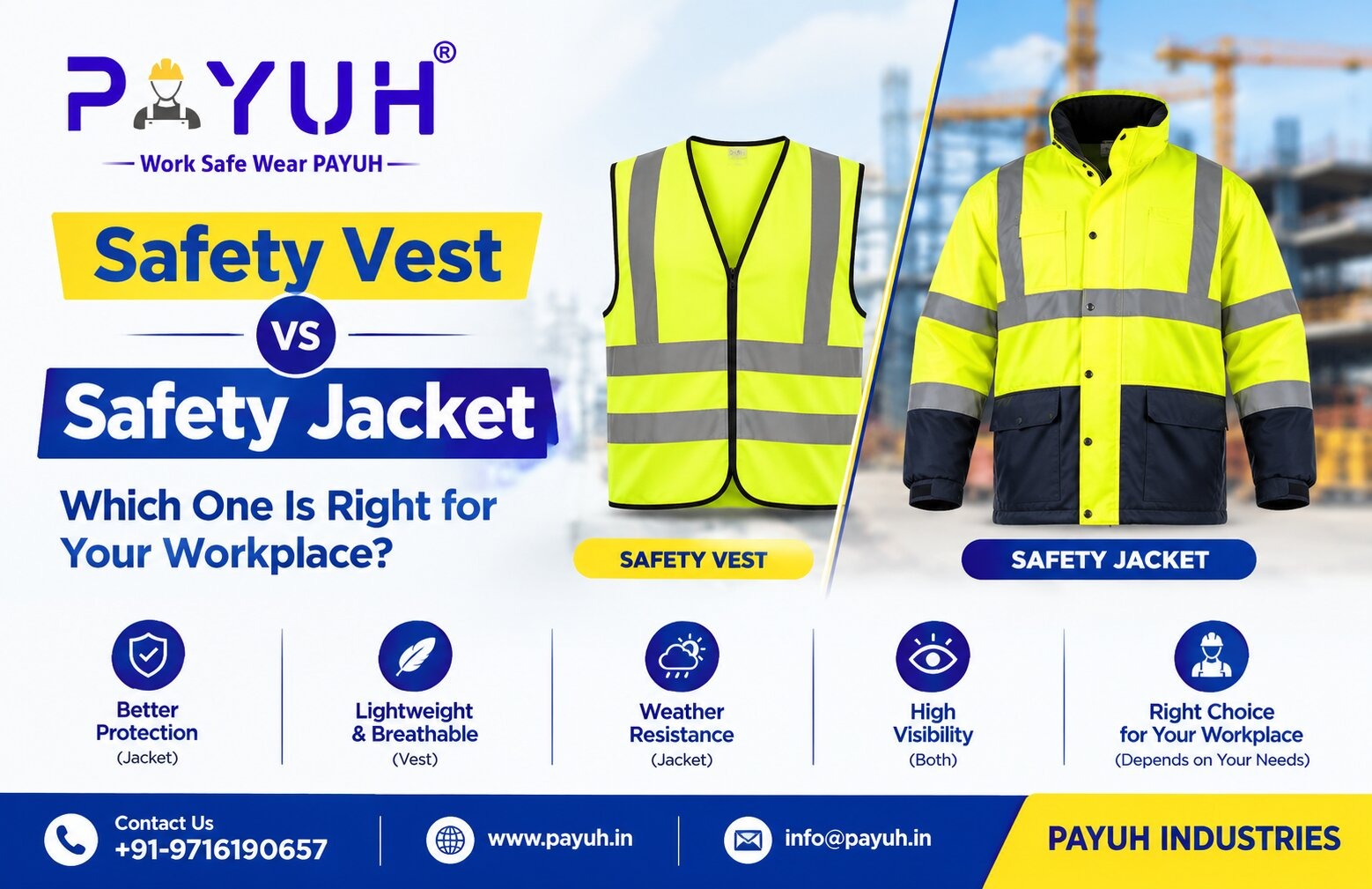
Workplace visibility is an important part of maintaining safety in construction sites, manufacturing plants, warehouses, roadwork zones, logistics operations, and other industrial environments. Employees who work around vehicles, machinery, moving equipment, or low-visibility areas need protective workwear that helps them remain clearly visible to coworkers and vehicle operators.
Two commonly used high-visibility options are safety vests and safety jackets. While both are designed to improve worker visibility, they serve different purposes depending on the working environment, weather conditions, job responsibilities, and level of protection required.
For businesses purchasing reflective safety jackets in bulk, choosing between a vest and a jacket is not simply a matter of appearance. The right choice should be based on workplace hazards, climate, comfort, durability, visibility requirements, and the nature of the job.
Reflective safety vest is lightweight high-visibility workwear designed primarily to make workers easier to see. It is commonly worn over regular uniforms or work clothing.
Safety vests are widely used in:
Many high-visibility vests use fluorescent fabrics and reflective strips to improve visibility during both daytime and low-light working conditions.
One of the biggest advantages of a safety vest is its lightweight construction. Workers can wear it over existing uniforms without feeling excessively warm or restricted, which makes it particularly useful in hot working environments.
Reflective safety jackets combine high-visibility features with greater coverage and, depending on its design, additional protection from environmental conditions.
Unlike a basic vest, a safety jacket covers the arms and upper body more extensively. Certain jackets may also provide protection against wind, rain, cold temperatures, or other workplace conditions.
Safety jackets can be particularly useful for:
For businesses operating across different seasons, jackets can offer a more versatile workwear solution.
The right option depends on the actual conditions in which employees work.
A reflective safety vest can be a practical choice when the primary requirement is visibility and workers need lightweight clothing. It is especially suitable for warm climates and indoor environments where additional protection against cold or rain is not necessary.
A safety jacket may be more appropriate when employees work outdoors, during colder weather, at night, or in environments where greater body coverage is beneficial.
Businesses should avoid selecting protective workwear solely on price. A low-cost product that does not suit the working environment may result in discomfort, poor compliance, or inadequate visibility.
Before placing a bulk order, businesses should evaluate where the workwear will actually be used.
Indoor Workplaces
For warehouses, factories, workshops, and indoor logistics facilities, lightweight safety vests may provide sufficient visibility without creating unnecessary heat.
Outdoor Construction Sites
Construction workers often face changing weather, dust, wind, and extended exposure to outdoor conditions. Depending on the season, a high-visibility jacket may provide greater practicality.
Road and Traffic Operations
Workers operating close to moving vehicles require excellent visibility. High-visibility workwear with appropriately positioned reflective elements can help workers stand out from their surroundings.
Night Shifts
Night-time operations require particular attention to visibility. Reflective components can help make workers more noticeable when illuminated by vehicle headlights or workplace lighting.
Cold or Rainy Conditions
Where workers are exposed to cold, wind, or rain, a jacket may offer advantages over a lightweight vest because it can provide additional coverage and weather protection.
The primary purpose of high-visibility workwear is to help workers remain noticeable.
However, simply choosing brightly coloured clothing is not enough. Businesses should consider:
The workwear should allow employees to remain visible without interfering with other protective equipment.
Even the best protective workwear will have limited value if employees do not want to wear it.
Comfort should therefore be part of the purchasing decision.
Businesses should look for workwear that provides:
For workers performing physically demanding tasks, excessive heat or restricted movement can quickly become a problem.
A lightweight vest may therefore be preferable in hot conditions, while a jacket may be more suitable when warmth and weather protection are necessary.
For B2B buyers, durability can be just as important as initial purchase price.
Construction and industrial workwear can be exposed to dust, abrasion, frequent washing, outdoor conditions, and daily wear. Businesses purchasing large quantities should evaluate the quality of fabric, stitching, reflective components, fasteners, and overall construction.
A durable product can help reduce frequent replacement and provide better long-term value.
When comparing suppliers, procurement teams should consider total cost of ownership, rather than focusing only on the unit price.
A safety vest or jacket is only one component of a complete workplace safety program.
Depending on the job, employees may also require:
The selected vest or jacket should work comfortably alongside the other PPE employees are required to wear.
For example, a jacket should not interfere with a safety harness, while a vest should not restrict access to essential equipment.
Before purchasing safety vests or jackets in bulk, procurement teams should assess the following:
1. Workplace hazards
Identify the primary risks employees face.
2. Working conditions
Consider indoor/outdoor work, temperature, rain, dust, and visibility.
3. Shift timings
Night-shift workers may have different visibility requirements from daytime employees.
4. Comfort and fit
Select sizes and designs that support unrestricted movement.
5. Product durability
Evaluate fabric, stitching, reflective elements, and overall construction.
6. Safety requirements
Check whether the products meet the applicable safety standards and workplace requirements.
7. Quantity availability
For large projects, confirm that the supplier can maintain consistent inventory and quality.
8. Supplier reliability
Look for dependable delivery, communication, product consistency, and after-sales support.
There is no single answer that applies to every workplace.
Choose a safety vest when your priority is lightweight visibility, especially in warm indoor or outdoor environments where additional weather protection is not required.
Choose a safety jacket when workers need greater coverage, weather protection, or additional practicality during outdoor, cold-weather, or extended-shift operations.
For companies with diverse operations, using both safety vests and safety jackets may be the most practical approach. Different departments, seasons, job roles, and work locations can have different requirements.
For B2B buyers, selecting a reliable PPE supplier is an important part of maintaining consistent workplace safety.
A professional supplier should be able to support businesses with suitable product options, bulk quantities, consistent quality, timely delivery, and guidance based on workplace requirements.
PAYUH INDUSTRIES provides PPE and industrial safety solutions for businesses operating across construction, manufacturing, infrastructure, and other demanding work environments.
From industrial safety helmets, safety jackets and high-visibility workwear to safety shoes and harnesses, businesses can evaluate PPE options according to their operational requirements.
For bulk procurement, organizations should focus on more than product availability. Quality, consistency, worker comfort, protection requirements, and dependable supply should all be considered before making a purchasing decision.
Is a safety vest better than a safety jacket?
Not necessarily. A safety vest can be suitable for lightweight visibility, while a safety jacket may be preferable when workers need greater coverage or work outdoors in cooler conditions.
What is a reflective safety vest used for?
A reflective safety vest is primarily used to improve worker visibility in environments such as construction sites, warehouses, road projects, logistics facilities, and industrial workplaces.
Who should use high-visibility safety jackets?
Workers operating outdoors, around vehicles, machinery, traffic, or in low-visibility conditions may require suitable high-visibility workwear. The exact requirements depend on the workplace and applicable safety practices.
Can safety vests and jackets be purchased in bulk?
Yes. Businesses, contractors, construction companies, factories, logistics companies, and infrastructure organizations can source safety workwear in bulk according to their project and workforce requirements.
What should I consider when buying industrial safety vests?
Consider the material, visibility, reflective tape, sizing, design, durability, workplace conditions, quantity requirements, and supplier reliability before making a bulk purchase.
Where can businesses source safety jackets and safety vests in India?
Businesses can work with established safety equipment manufacturers and suppliers that can understand their application requirements and provide suitable products for their workforce and projects.
Choosing between a safety vest and safety jacket depends on the workplace—not simply on the product itself.
A vest can provide lightweight and practical visibility, while a jacket can offer greater coverage and additional protection against environmental conditions. The best choice depends on the work environment, weather, shift timing, hazards, worker comfort, and PPE requirements.
For businesses purchasing safety workwear in bulk, a careful assessment of these factors can help improve workplace visibility, employee acceptance, and overall PPE value.
Need safety workwear for your business? Explore suitable PPE solutions from PAYUH INDUSTRIES and choose products based on your workplace requirements, workforce size, and operational conditions.