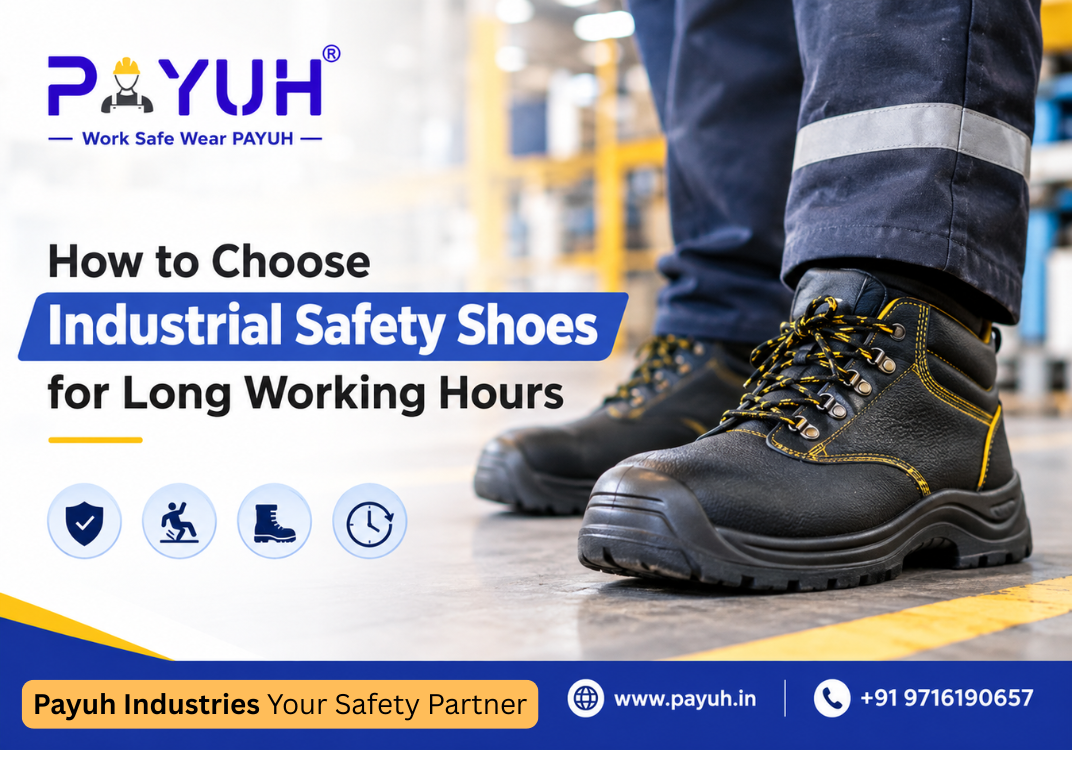
For workers who spend 8, 10 or more hours on their feet, the right safety shoes are more than basic protective equipment. They can affect comfort, mobility, stability and how easily workers can perform their daily tasks.
For businesses, choosing industrial safety shoes also involves more than comparing prices. Procurement teams need to consider workplace hazards, shoe construction, sole performance, toe protection, fit, durability and the requirements of the job.
A pair that looks suitable on paper may not be the right choice for a factory floor, construction site, warehouse, workshop or outdoor work environment.
So, how do you choose industrial safety shoes for long working hours?
The best approach is to start with the work environment and then evaluate protection, comfort and durability together.
Industrial workers can face several foot-related hazards during their working day. These may include falling or rolling objects, sharp materials, slippery surfaces, electrical risks, hot surfaces, chemicals and other workplace conditions.
OSHA recommends assessing the actual hazards present in the workplace before selecting protective footwear. Different hazards may require different types of protection, such as impact, compression, puncture or slip resistance.
For employees working long shifts, protection is only one part of the decision.
If footwear is uncomfortable, poorly fitted or unsuitable for the working environment, workers may experience discomfort and fatigue during the day. For businesses, this can make employee acceptance and consistent PPE use more difficult.
That is why industrial footwear procurement should consider safety + comfort + durability + workplace suitability.
Before selecting a safety shoe model, identify what workers actually face during their shifts.
For example:
The correct specification depends on the application.
For B2B buyers, this step is important because ordering the same footwear for every department may not always be appropriate. A company with multiple work environments may need different footwear specifications for different teams.
Toe protection is one of the first features many businesses consider when purchasing safety shoes for industrial and construction.
Safety-toe footwear can help protect workers from certain impact and compression hazards. OSHA guidance identifies falling or rolling objects as examples of workplace hazards where appropriate protective footwear may be required.
However, businesses should not select footwear simply because it has a protective toe.
Consider:
For long shifts, the shoe should provide the required protection without creating unnecessary discomfort.
A good sole can make a significant difference in industrial environments.
Workers may walk across concrete floors, metal surfaces, workshops, warehouses, ramps or outdoor areas. If the workplace has wet, oily or slippery surfaces, slip resistance becomes an important consideration.
OSHA's foot-protection guidance specifically identifies wet and slippery surfaces among hazards that should be considered when selecting protective footwear.
When comparing industrial safety shoes, businesses should examine:
The right sole should be selected according to the actual working conditions rather than based only on appearance.
Fit becomes especially important when workers wear safety shoes throughout a full shift.
A shoe that is too tight can create pressure points. A shoe that is too loose may reduce stability and cause unnecessary movement inside the footwear.
Before placing a large B2B order, companies should consider conducting a size assessment or allowing workers to test shortlisted models.
Check:
OSHA's PPE guidance also emphasizes selecting PPE that properly fits the employee.
For bulk procurement, collecting employee size requirements in advance can also reduce exchanges and avoid unnecessary inventory problems.
Safety footwear needs protective components, but that does not mean heavier is always better.
Employees who walk or stand for several hours may notice the weight of their footwear throughout the working day.
When evaluating different models, procurement teams should compare:
The objective is to find a practical balance between protection and everyday wearability.
A construction worker and a warehouse employee, for example, may have very different footwear requirements even if both work eight-hour shifts.
Long working hours can mean extended contact between the foot and the inside of the shoe.
Depending on the work environment, businesses may want to consider footwear construction, ventilation and moisture management when comparing models.
For indoor factories and warehouses, breathable construction may be useful where conditions allow it. For wet or outdoor environments, water resistance or waterproof footwear may become more important.
The key is to avoid choosing footwear based on one feature alone.
Ask:
Where will employees wear the shoes, and what conditions will they face throughout the shift?
This simple question can help procurement teams narrow down suitable options.
Not every industrial workplace has the same environmental conditions.
If workers regularly encounter water, oil or specific chemicals, standard safety shoes may not provide the protection required for that environment.
OSHA identifies chemical exposure, wet surfaces and other environmental hazards as factors that can influence foot-protection selection.
For procurement teams, it is therefore useful to document the working environment before choosing a model.
For example:
|
|
|
|
|
|
|
|
|
|
|
|
|
|
|
|
The exact specification should always be matched to the identified workplace hazard.
For businesses purchasing footwear for dozens or hundreds of workers, durability directly affects procurement costs.
A low initial purchase price may not represent the lowest overall cost if footwear needs frequent replacement.
Look at:
Businesses should also consider how frequently employees use the footwear and the intensity of the work.
A shoe designed for occasional use may not be the right choice for workers wearing it every day.
Safety footwear should be evaluated against the standards and certification requirements applicable to the intended workplace and market.
Avoid relying only on statements such as "industrial grade" or "heavy duty."
Instead, procurement teams should ask suppliers for relevant documentation and verify that the footwear specification matches the company's safety requirements.
Depending on the market and application, buyers may encounter standards relating to impact protection, compression, puncture resistance, electrical properties, slip resistance and other performance characteristics.
For B2B procurement, maintaining product documentation can also make internal safety reviews and supplier evaluations easier.
When a company purchases safety shoes for workers, the buying decision becomes more complex.
Procurement teams may need to consider:
For example, a factory purchasing 200 pairs may need a supplier capable of maintaining consistent specifications across multiple sizes and future replenishment orders.
This is why B2B buyers should evaluate the supplier as carefully as the product.
One practical step can reduce procurement mistakes: test before buying in bulk.
Instead of immediately ordering a large quantity, businesses can shortlist suitable models and allow representative workers to test them in actual working conditions.
Ask employees about:
This provides useful feedback before the company commits to a large purchase.
It can also help identify whether the selected model works equally well across different departments.
Businesses sometimes focus heavily on price and overlook other important factors.
Here are some common mistakes:
The cheapest option may not provide the right combination of protection, comfort and durability.
Different departments can have different hazards and working conditions.
If employees find footwear uncomfortable during long shifts, consistent use may become more difficult.
Incorrect size distribution can create unnecessary exchanges and delays.
B2B buyers should request relevant product specifications and certification documents where applicable.
A sample or trial phase can reveal practical issues before a large procurement order.
Before finalizing a B2B safety footwear order, procurement teams can use this simple checklist:
Workplace
What hazards are present?
Are workers standing or walking for most of the shift?
Is the environment wet, oily, dusty or uneven?
Protection
Comfort
Durability
Procurement
For a business, industrial safety footwear is not simply another item on a PPE purchase list.
The right footwear should support the safety requirements of the workplace while being practical enough for employees to wear throughout their shifts.
A thoughtful procurement process can also help companies avoid common purchasing problems such as unsuitable specifications, poor fit, frequent replacement and inconsistent supply.
Most importantly, footwear selection should begin with the workplace hazard, not simply the product catalogue.
Whether you are purchasing safety footwear for a construction project, factory, warehouse, workshop or industrial facility, start by understanding the working environment and the risks employees face.
Then compare protection, fit, sole performance, construction, durability and applicable standards.
For businesses purchasing safety footwear in bulk, working with an experienced PPE supplier can make the selection process easier and help ensure that the chosen footwear matches the intended application.
PAYUH Industries provides industrial safety products for businesses and workplaces, including safety footwear and other PPE solutions.
If your company is planning a bulk safety footwear requirement, discuss your workplace application, employee requirements and quantity with the PAYUH team before finalizing your order.
Protect your workforce with PPE selected for the job—not simply the lowest price.
Look for appropriate protection, proper fit, suitable sole grip, reasonable weight, durable construction and features suited to your workplace environment. The right combination depends on the hazards workers face.
They can be, provided the footwear is correctly selected and properly fitted for the job. For long shifts, businesses should pay particular attention to fit, weight, comfort and sole performance in addition to protection.
Start with a workplace hazard assessment. Consider falling or rolling objects, machinery, sharp materials, slippery floors, oil exposure and other relevant risks. Then select footwear with protection and construction appropriate to those conditions.
Yes. A small trial with representative employees can help procurement teams evaluate fit, comfort, grip and practical performance before placing a larger order.
Assess each department separately. Construction, warehouse, manufacturing, electrical and outdoor teams may face different hazards, so the same safety shoe may not be suitable for every employee.
Proper sizing helps provide a secure and comfortable fit. For companies placing bulk orders, collecting employee size requirements beforehand can reduce exchanges and improve procurement efficiency.
There is no single feature that is suitable for every workplace. The starting point should be the actual workplace hazard assessment, followed by protection, fit, comfort, durability and applicable requirements.